There is a particular kind of exhaustion that comes from always being the person who fixes things.

The one who apologizes first.
The one who smooths over tension.
The one who absorbs discomfort so everyone else can feel comfortable again.
For many people — especially within families — this role develops slowly and quietly. It rarely begins with obvious conflict. Instead, it grows through subtle patterns: misunderstandings that always circle back to you, conversations about you instead of with you, or a feeling that no matter what happens, responsibility somehow lands in your lap.
When these patterns finally become visible, the realization can feel shocking.
But it can also be deeply clarifying.
Reputation Management and Relational Aggression
Healthy relationships rely on direct communication. Problems are addressed openly and accountability is shared.
Unhealthy dynamics often look very different.
Reputation management, in its unhealthy form, occurs when someone attempts to control how others perceive a situation — or a person — rather than addressing conflict honestly.
This may include:
- selective storytelling,
- exaggeration or omission of important details,
- presenting concern as kindness while planting doubt,
- or positioning themselves as the reasonable or wounded party while subtly implying another person is difficult.
Alongside this is relational aggression — conflict expressed through relationships instead of direct confrontation.
It may appear as:
- exclusion or selective invitations
- withholding information
- gossip disguised as worry
- backhanded compliments
- triangulation (talking about someone instead of to them)
- or influencing others’ opinions behind the scenes
Because these behaviors are rarely loud or dramatic, the person experiencing them often doubts their instincts for a long time.
Many people initially assume they are simply being “too sensitive.”
Often, they are actually noticing patterns.
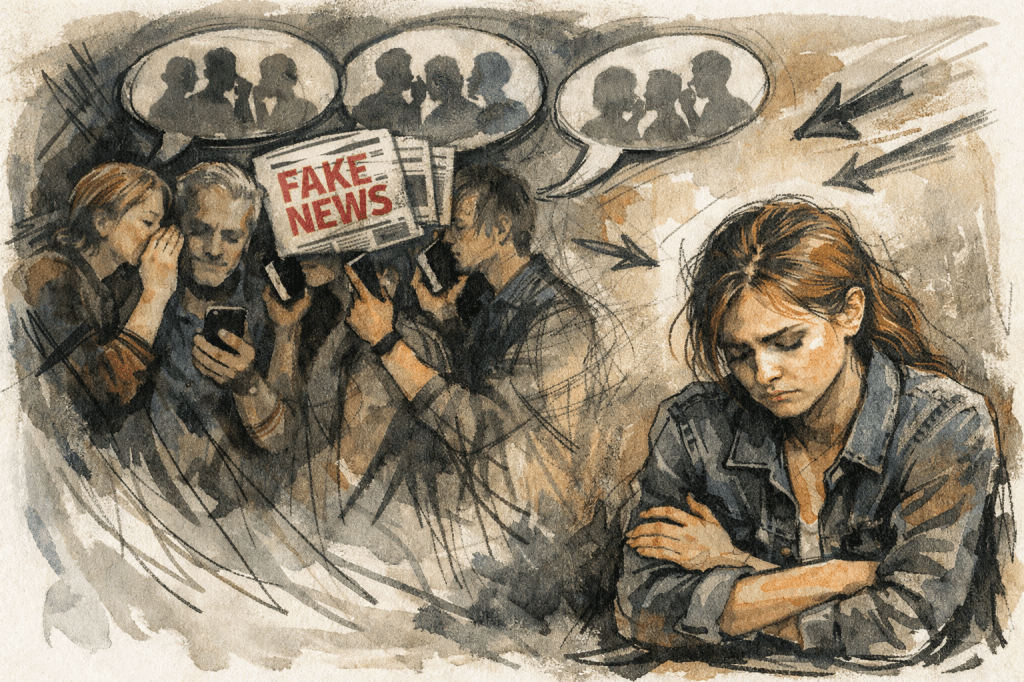
Why Someone Tries to Control a Narrative
Attempts to reshape another person’s reputation are rarely random.
Sometimes it comes from insecurity or comparison.
Sometimes from fear of losing influence.
Sometimes from jealousy or discomfort when someone else grows emotionally healthier.
People may try to elevate themselves socially by creating contrast — building themselves up while quietly positioning another person as less capable, less stable, or less connected.
Ironically, those targeted are often individuals who:
- avoid gossip,
- value honesty,
- or refuse to participate in social maneuvering.
Calm authenticity can unintentionally threaten someone invested in controlling perception.
The Family Scapegoat or “Truth-Teller”
Within families, long-standing emotional roles often develop without anyone consciously choosing them.
One person becomes the peacemaker.
Another avoids conflict.
Someone becomes the caretaker.
Sometimes one individual becomes the person blamed when tension arises — the scapegoat — or the one who notices uncomfortable truths others would rather avoid.
Common signs include:
- Being blamed for problems you did not create.
- Having your memories or experiences questioned.
- Hearing phrases like “you’re crazy.” “Why can’t you just let it go?” … when you finally don’t let it go.
- … Note: Clinicians call the “ You’re Crazy” label the most unproductive no-no. The absolute worst thing you can do to someone.
- Being expected to tolerate behavior others are not asked to tolerate.
- Acting as the emotional listener or fixer for everyone else.
- Experiencing pushback when you grow, change, or set boundaries.
- Being described very differently by friends or colleagues than by family narratives.
- Feeling responsible for restoring peace even when you were hurt.
Many empathetic or emotionally aware people fall into this role because they value harmony.
Ironically, compassion can become the very trait others rely on unfairly.
The Pattern of Always Apologizing First
Apologizing is not weakness. In healthy relationships it reflects maturity and empathy.
But when one person consistently apologizes first — regardless of who caused harm — the balance shifts.
Over time:
- others may stop examining their own behavior
- accountability becomes uneven
- and repair becomes expected rather than appreciated
The emotional labor quietly becomes one-sided.
Many people in this role apologize because silence feels unbearable. They want resolution. They want safety restored.
But automatic repair teaches others they never have to step forward.
Eventually the apologizer may feel invisible, misunderstood, or emotionally depleted without fully understanding why.
What Happens When You Stop Carrying Everything
Many people fear that if they stop fixing conflict immediately, relationships will collapse.
Often something else happens.
At first, discomfort appears.
Silence replaces the familiar cycle. Some people may become irritated or increase pressure to pull the old dynamic back into place.
This period can feel unsettling.
But it reveals important truths.
Some relationships become healthier when responsibility becomes shared.
Others reveal they depended on one person carrying all the emotional work.
Both outcomes bring clarity.
Quiet Signs a Narrative Has Been Built About You
Many people recognize reputation manipulation when they notice:
- others suddenly acting differently without direct conflict,
- hearing distorted versions of conversations,
- exclusion followed by casual mentions meant to be overheard,
- or feeling subtly isolated without understanding why.
These experiences can feel deeply personal.
But people often trust their own direct experiences over time. Consistent behavior quietly corrects misinformation more effectively than emotional defense.
Calm Ways to Protect Yourself Without Creating Drama
Change does not require confrontation or hostility.
Often the strongest responses are quiet ones.
Speak directly when necessary.
Simple clarity works better than long explanations.
Strengthen direct relationships.
Authentic connection dissolves misunderstanding faster than defending yourself through intermediaries.
Apologize only for your part.
“I’m sorry I raised my voice” is very different from apologizing for an entire situation.
Reduce oversharing with those who misuse information.
Allow pauses.
If someone else owes accountability, give them space to step forward.
Do not compete socially.
Confidence rarely needs advertisement.
Consistency over time speaks louder than arguments.
A Gentle but Important Truth
When someone steps out of a scapegoat or repairer role, pressure sometimes increases temporarily.
Old systems resist change because familiarity feels safe.
That pressure does not mean you are wrong.
It often means the dynamic itself is shifting.
People who rely on relational aggression frequently underestimate how perceptive others are. Over time, patterns become visible without dramatic exposure.
Healthy relationships do not require constant self-sacrifice to survive.
They require mutual respect.
And sometimes the most powerful step toward peace is not proving yourself louder — but simply choosing not to carry what was never yours to hold.

Other Sources
Research / Academic Reviews
Relational Aggression Research Review:
Family Violence & Scapegoating Research:
American Psychological Association Emotional Abuse Overview:
⭐ Trauma & Family Systems Education
Dr. Ramani (Clinical Psychologist — Narcissistic Family Systems):
Patrick Teahan LICSW (Family Trauma Therapist):
https://www.youtube.com/@patrickteahanlicswtherapy
HealthyGamerGG — Dr. K (Harvard Psychiatrist):
https://www.youtube.com/@HealthyGamerGG
⭐ Highly Recommended Books (Experts)
Adult Children of Emotionally Immature Parents — Lindsay Gibson:
Complex PTSD: From Surviving to Thriving — Pete Walker:
https://www.pete-walker.com/complex_ptsd_book.html
The Gaslight Effect — Robin Stern:
 Live Life Free